For more than three decades, Saroj Bajracharya has occupied a distinctive position within Nepal’s contemporary art landscape—as a painter, writer, curator, art educator, and persistent observer of the ways in which culture, memory, and consciousness shape human experience. His practice does not belong exclusively to one discipline. Rather, painting, art history, critical writing, curatorial inquiry, and education form interconnected parts of a continuing intellectual and artistic journey.
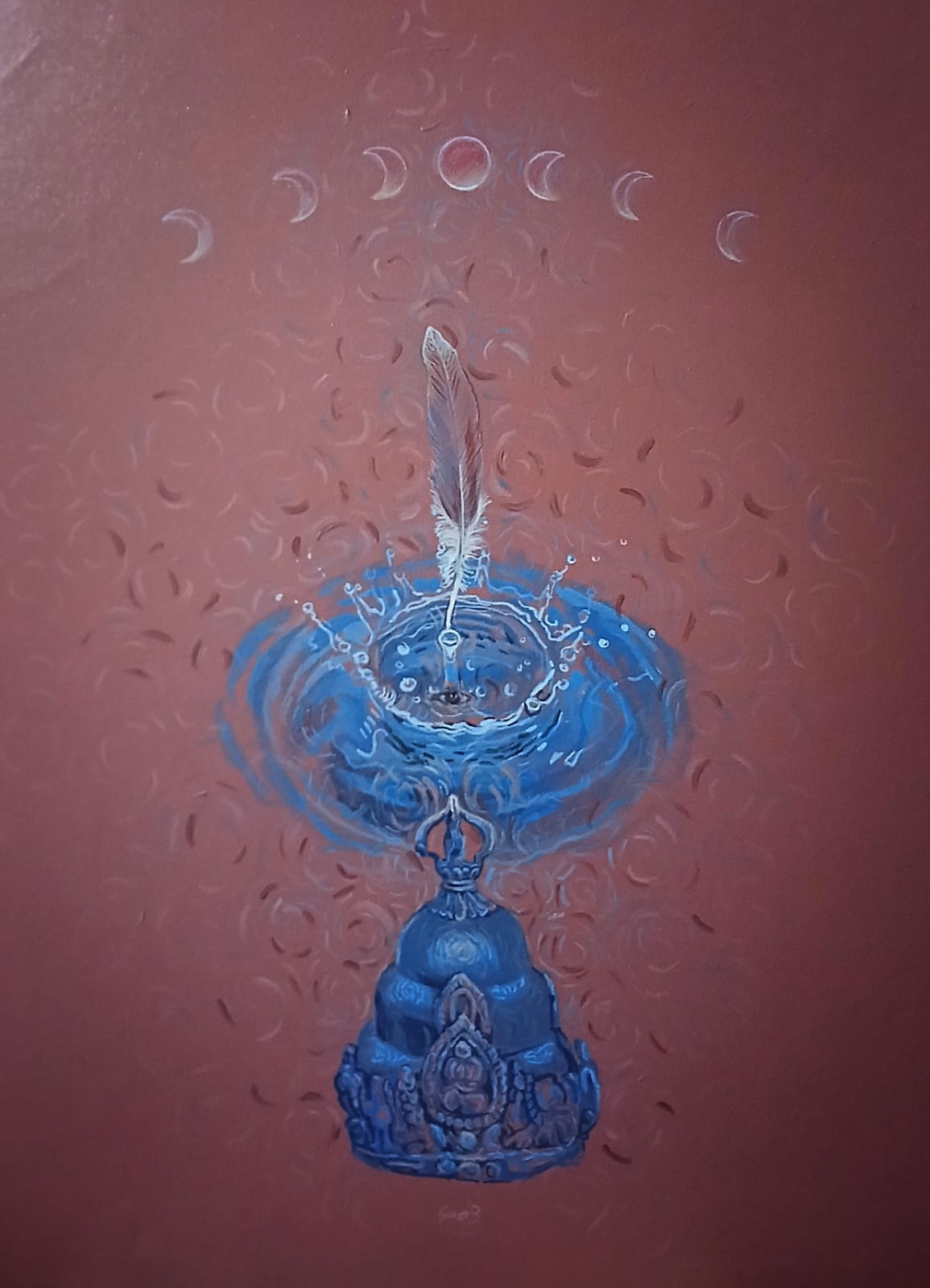
At the centre of Bajracharya’s work is a fundamental curiosity about existence: how ancient ways of understanding the world continue to inhabit the present, how memory survives beyond the moment that produced it, and how human beings locate themselves within a universe that remains only partially understood. His paintings emerge from this space of uncertainty, where the visible world becomes a threshold to what cannot be immediately seen.
Bajracharya draws upon ancient cosmologies, mythology, ritual traditions, nature, celestial imagery, memory, and everyday experience. Yet his engagement with these sources is neither nostalgic nor illustrative. The past, for him, is not a closed historical territory. It remains active within the present—transformed, fragmented, remembered, and continually reinterpreted. Cultural memory therefore becomes less a repository of inherited images than a living force capable of entering contemporary consciousness in unexpected forms.
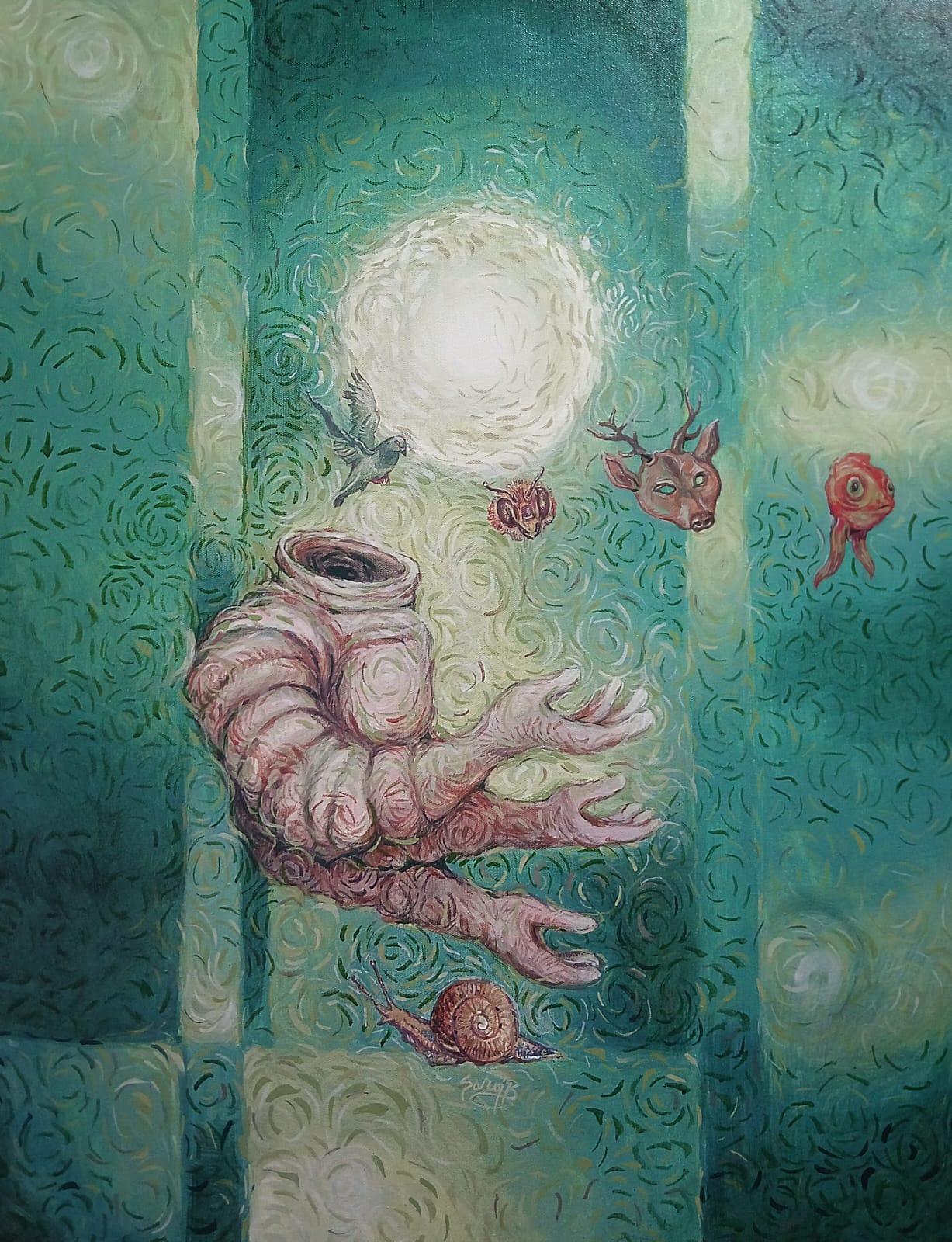
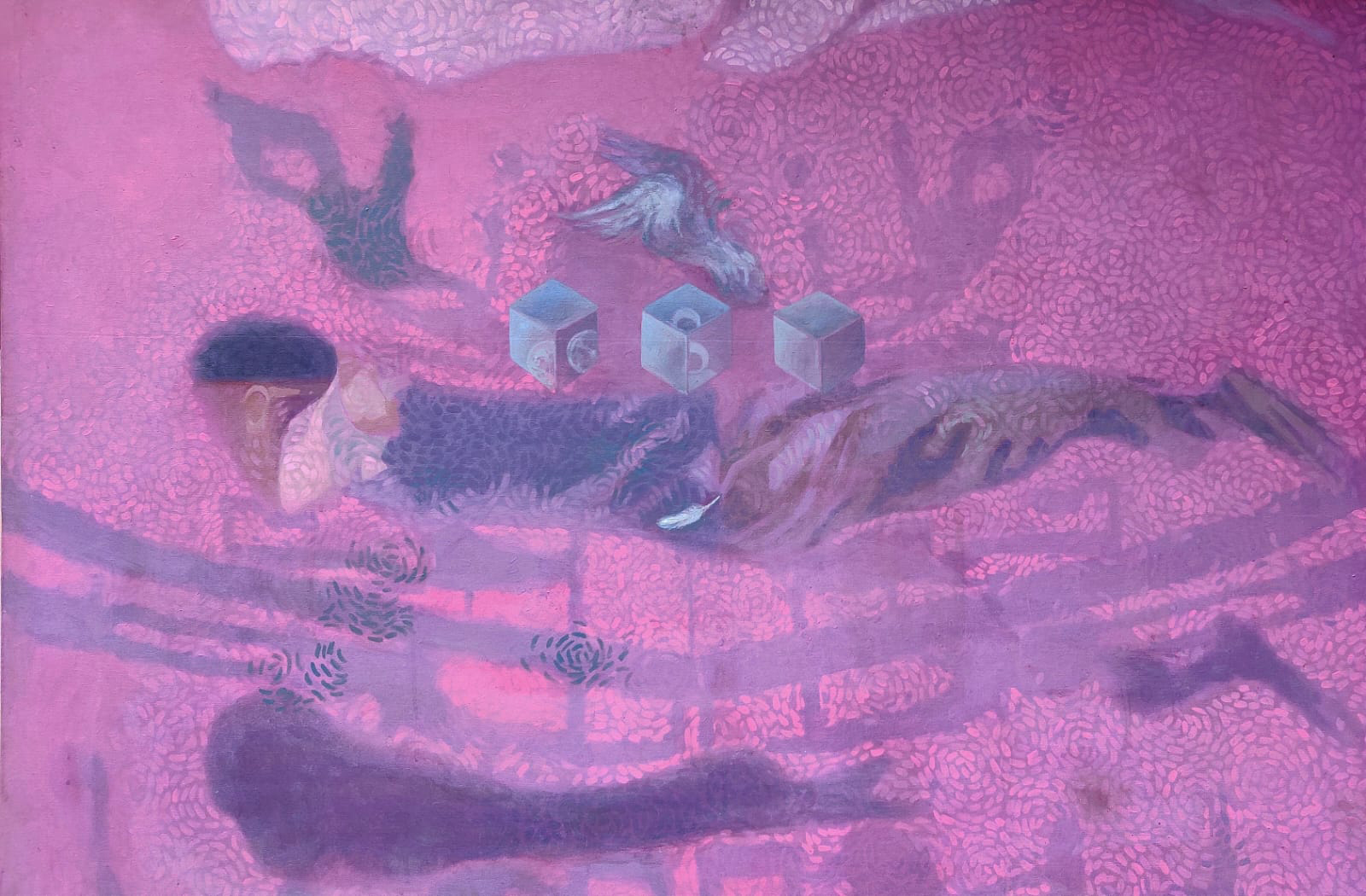
His paintings often inhabit the space between recognition and abstraction. Human and animal forms, celestial bodies, organic structures, architectural fragments, and imagined objects coexist within carefully constructed compositions. Geometric divisions, vertical rhythms, tonal contrasts, and tactile surfaces introduce an architecture of order against which instinct, ambiguity, and primal impulses can unfold. This tension between structure and instinct is central to his visual language.
The human figure, when present, is rarely an isolated protagonist. It exists within a larger field of beings and forces—animals, nature, objects, memories, celestial phenomena, and imagined presences. Such relationships question the assumed boundaries between human and more-than-human, nature and culture, matter and consciousness. His work repeatedly returns to the possibility that existence may be more interconnected than conventional perception allows us to recognize.
Time and transformation are equally important to Bajracharya. He does not regard the past as something that has simply disappeared. Instead, it persists as an invisible layer within the present. Images and ideas migrate across generations, acquiring new meanings as they encounter new circumstances. In this sense, memory becomes almost architectural: something through which we move, something that surrounds us, and something that continues to shape us even when we can no longer identify its source.
This philosophical concern extends into Bajracharya’s writings on Nepali modern art. As the author of Art Evolves: Nepali Modern Art and co-author of A Concise Introduction to Nepali Modern Sculpture, he has contributed to the documentation and critical understanding of Nepal’s modern and contemporary artistic development. His extensive writings for newspapers, magazines, exhibition catalogues, and other publications reflect an engagement not merely with individual artworks, but with the larger intellectual conditions through which Nepali art has evolved.
His curatorial practice similarly reflects this desire to bring apparently separate histories and forms of knowledge into dialogue. Projects such as Future of History (2010–2011), Fables on the Floor (2016), Appearance of Light (2019), and Mythical Real: Narratives of Coexistence and Transformation (2026) demonstrate an ongoing interest in cultural memory, mythology, contemporary imagination, and interdisciplinary artistic practice. Rather than treating tradition and contemporaneity as opposing categories, his projects explore the spaces where they overlap, collide, and transform one another.
His participation in the 2008 Cultural Partnership Initiatives (CPI) curatorial programme, conducted in collaboration with the National Museum of Modern and Contemporary Art, South Korea, further expanded this engagement beyond Nepal and introduced another dimension to his understanding of curatorial practice and international artistic exchange.
Education forms another essential dimension of his work. For Bajracharya, teaching is not separate from artistic practice; it is another way of participating in the transmission and transformation of knowledge. Through art education, he has contributed to the development of younger generations of artists while remaining engaged with the broader questions of how art is understood, taught, remembered, and carried forward.
Ultimately, Bajracharya’s practice is concerned less with providing answers than with creating conditions for contemplation. His paintings do not attempt to resolve the mysteries they evoke. Instead, they occupy an uncertain territory between matter and memory, mythology and modernity, instinct and structure, the visible and the unseen.
He paints not simply what is known, but what might exist beyond the limits of knowing.
This position gives his work its particular character. Ancient cosmologies become contemporary questions; memory becomes a living presence; mythology becomes a language rather than a fixed narrative; and the ordinary world becomes capable of revealing something beyond itself.
Across painting, writing, curating, and education, Saroj Bajracharya’s continuing inquiry remains fundamentally the same: to look beyond habitual ways of seeing and to enter that uncertain space where matter, memory, imagination, and consciousness meet.
His art begins there—at the edge of what we recognize—and remains open to whatever may be waiting beyond it.